Build Your Fantasy Cake and We'll Read Your Sweet Side
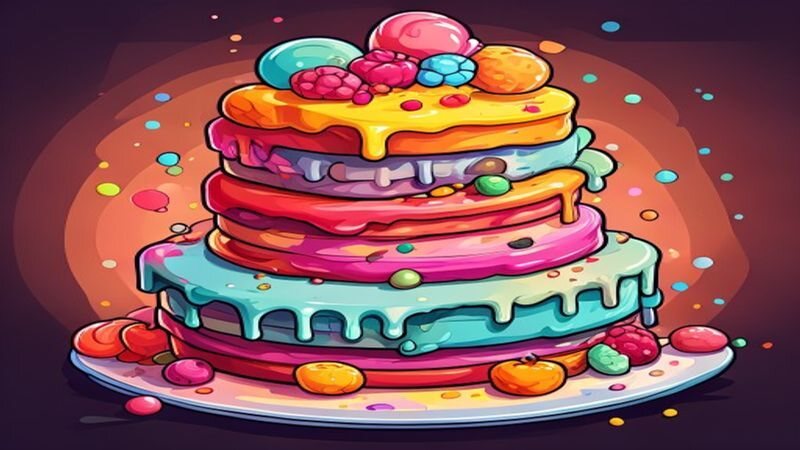
Cake is autobiography with frosting. Every decision — the base, the filling, whatever ends up on top — says something you would never admit out loud, like whether you crave an audience or simply want everything to taste the way your grandmother's kitchen smelled.
Build the fantasy version here: no budget, no oven limits, no judgment from us. Fine, some judgment. Once the last layer is placed you receive a verdict on your sweet side, ranging from tasteful minimalist to full centerpiece energy. Aprons optional. Honesty mandatory.
See every possible result for this quiz and what each one means →
Cake got easy only when chemistry turned up
A tall, tender sponge is a fairly modern luxury. For most of baking history a sweet raised batter meant either yeast, which needs time and does odd things to flavour, or an enormous amount of beaten egg. That is still how a genoise works: whisking eggs and sugar to a stable foam is mechanical aeration, air forced in by arm.
Bicarbonate of soda changed the arithmetic by supplying carbon dioxide on demand, so long as something sour was in the bowl to react with it, which is why so many older recipes call for buttermilk, soured cream, treacle or vinegar. Baking powder went further by packaging the alkali with a dry acid, so nothing happens until liquid and heat arrive. Alfred Bird, working in Birmingham in the 1840s, is usually credited with an early version, and Eben Norton Horsford later patented a phosphate formulation in the United States.
Red velvet is an accident, mirror glaze is optics
Natural cocoa, the sort not treated with alkali, carries pigments that shift reddish in acidic company. Pair it with buttermilk and a splash of vinegar and old recipes produced a muted mahogany blush long before anyone reached for a bottle of colouring. Dutch-processed cocoa, alkalised for a mellower flavour, loses the trick entirely.
A mirror glaze is a warm gel, usually set with gelatin, poured so it settles into an almost perfectly smooth skin. Light bounces off that skin at a single angle instead of scattering, which is what gives you a reflection you can check your fringe in. One trapped bubble breaks the surface and the mirror turns matt at that spot.
Mostly, you want the cake you were given
A liking for sweetness shows up extremely early in life, but a liking for a specific frosting is learned at somebody's kitchen table. Most of what we call flavour is aroma arriving through the back of the nose, and smell has unusually direct traffic with the brain regions that handle memory, which is why one particular icing can drop you into a room you have not stood in for thirty years. Researchers studying odour-triggered autobiographical memory sometimes label it the Proust phenomenon.
So the quiz below is a game. Your dream cake is a decent record of what you were fed and who fed it to you. It is not a personality reading, and we would not pretend otherwise.