The Chameleon Color Dare: 9 Out of 10 Players Tap Out
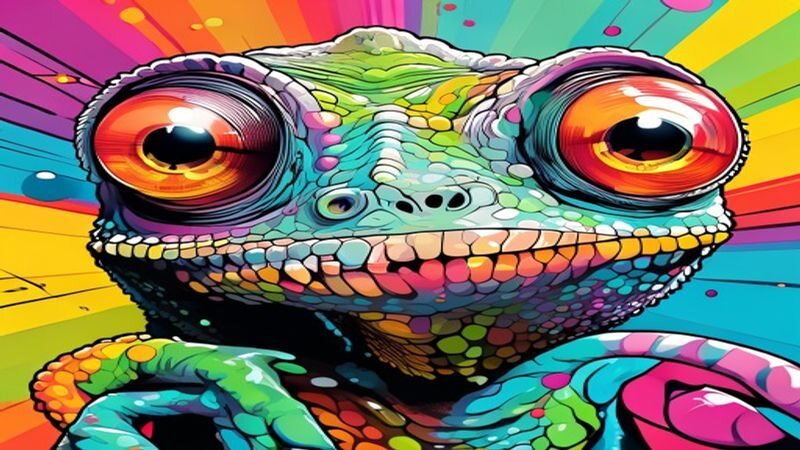
Chameleons have one job: making your eyes lie to you. This little green trickster has hidden itself inside seven color puzzles — odd shades out, letters that almost match, paint mixes that almost work — and it is frankly convinced you will fold before question five, because that is where most players do.
My money says you are sharper than the average lizard-hunter, but eyes get cocky. Read every option twice, distrust anything that looks too familiar, and go prove the reptile wrong.
See every possible result for this quiz and what each one means →
The colour change runs on crystals, not pigment alone
For a long time the assumption was that chameleons simply shuffled pigment around inside their skin cells. In 2015 a team led by Michel Milinkovitch at the University of Geneva reported something stranger in panther chameleons: a layer of cells packed with a tidy lattice of guanine nanocrystals. Relax or tighten that lattice and the spacing between crystals changes, which changes the wavelength the skin reflects, sliding an animal from blue-green towards yellow, orange and red.
That is structural colour, the same physics behind a beetle's shell or a soap film, and it can be tuned in seconds. The researchers also described a deeper crystal layer that reflects near-infrared, which probably has more to do with heat than display.
It is a conversation, not a hiding place
The cartoon version, where a chameleon on tartan turns tartan, is not a thing that happens. Their resting greens and browns already resemble foliage, so camouflage is roughly the default state, and the dramatic changes are signals laid on top of it. Males flare into bright, high-contrast display when facing a rival or courting; a dark, drab animal is often cold, stressed or backing down.
Temperature matters too. Darker skin absorbs more heat, so a cool morning lizard has good reason to go sombre before the sun is properly up, and to lighten once it has warmed through. Species differ enormously in how much range they have, and a great many of the roughly two hundred known species barely shift at all.
The rest of the equipment is just as odd
Each eye sits in a turret of fused eyelid with a small aperture, and the two swivel independently, letting the animal scan almost all the way around itself. When something edible appears, both eyes converge on it to judge distance, and then the tongue is fired using elastic energy stored in collagen tissue, among the quicker movements any vertebrate manages.
Naming shades on a screen has nothing to do with any of this, of course. The quiz is a bit of fun wearing a lizard costume.